

Description
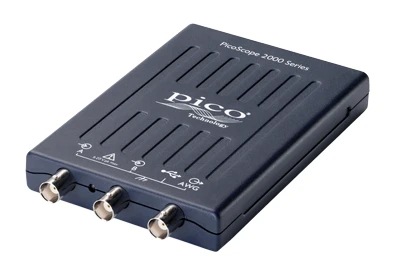
The PicoScope 2000 Series: Benchtop performance, pocket size
Analog and digital inputs, plus a built-in waveform generator. Why buy lots of instruments when you can just buy one?

Entry-level price, high-end features
The PicoScope 2000 Series offers up to 100 MHz bandwidth, sampling rates up to 1 GS/s and deep memory up to 128 MS; this compact oscilloscope is incredibly capable, and yet fits on the busiest of desks with no problem.
More than just oscilloscopes, all models include a built-in function and arbitrary waveform generator. Generate pre-defined signals such as sine or square waves, with useful test and debugging features like user-defined frequency sweeps. Or use the arbitrary waveform generator to produce any signal you can draw (and you can import CSV files too!).
Mixed-signal models include a 16-channel digital input for powerful debugging. All of the PicoScope 2000 Series oscilloscopes are powered over USB to maximize portability and convenience.

A complete test and measurement lab, straight out the box
When you buy a PicoScope, it’s yours. All of it. There are no subscriptions, upgrades, hidden fees or paywalls. With regular free software updates, you’ll always have an up-to-date oscilloscope to hand. Use the wide range of serial decoders (39 and counting!), measurements, mask tests and automation actions to power your testing and measuring.
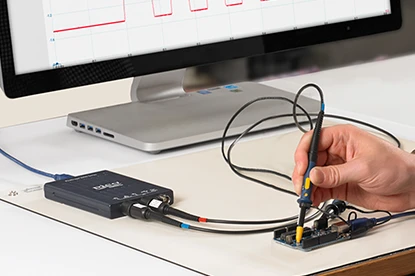
So many low-bandwidth oscilloscopes force you to peer at a tiny, low-resolution screen. Not so with the PicoScope 2000 Series – plug in to your PC and add as many viewports as you like so you can see everything clearly.
Just getting started with PicoScope, or looking for help porting your custom PicoSDK application from Windows to Raspberry Pi? Free help from Pico’s tech support team is always available, whether you’re a beginner or an engineering pro.
Oscilloscopes that don’t compromise on quality
The PicoScope 2000 Series offers oscilloscopes with bandwidths from 10 to 100 MHz, with the 2000A models offering unbeatable value and the 2000B models offering higher bandwidth and deeper memory for advanced analysis.
PicoScopes offer unbeatable flexibility. The tools and features included with your scope are the same across the range:
• Use resolution enhancement to add up to 4 bits of vertical resolution
• Use ETS mode to increase the effective sampling rate by up to 20 times
• Use analysis tools like measurements and serial decoders, included free in PicoScope 7
Simple to use
Easy to set up, just plug in your scope and power up PicoScope 7, and you’re ready to go. Because PicoScopes use your PC’s screens, opting for a lower-bandwidth model doesn’t mean peering at a low-resolution screen with an out-of-date interface. Customize the layout so the tools you use most are always available, not hidden in menus.
For users unfamiliar with the software, help is always at hand. The software includes tooltips to explain features, plus links to in-depth articles that will guide you through your measurements, from the basics of setup to advanced features.

In-depth analysis
The PicoScope 2000 Series oscilloscopes come with up to 100 MS of on-board storage. Using PicoScope 7, this can be split into up to 40 000 individual buffers (10 000 on A models). Segmented memory lets you trigger on a specific event type and capture multiple examples, without recording all the dead space in between. Most oscilloscopes in the series use advanced hardware acceleration to achieve up to 80 000 waveforms per second, indicating a quick rearm time, helping you spot that one elusive glitch.
Use DeepMeasure to compare results across buffers, or use measurements to filter the captured waveforms to just those of interest, and use the waveform navigator to quickly find what you need.

Excellent dynamic performance
The PicoScope 2000 Series has noise as low as 150 μV RMS, less than −50 dB of harmonic distortion and an SFDR of more than 52 dB. Use the built-in spectrum analyzer to hunt down sources of noise, design analog filters and analyze distortion in signal chains.
The spectrum analyzer view, with its own selection of handy measurements, is ideal for demonstrating principles such as signal harmonics, interference and signal integrity.

 Account
 Categories
 Search
 Compare
 Top
Top
Reviews
There are no reviews yet.